Collagen on the skin: myth or true effectiveness?
Collagen is something of a magic word in skincare. You see it everywhere—in jars of cream, serums, sheet masks, and ads that promise "plumped-up" skin in three days and highlight the benefits of collagen.
Naturally, one eventually asks a very simple question: Does it really work when applied to the skin? Or is it mostly just good marketing?
The answer, as is often the case, is a bit frustrating. Yes, there are effects. But not the ones many people imagine. And it depends enormously on the form of collagen, the formula, and especially on what results you expect.
Let's break it all down calmly.
What exactly is collagen?

Collagen is a protein. And not a small protein. It is literally one of the pillars of your tissues. Skin, tendons, ligaments, cartilage... it's everywhere.
In the skin, its role is quite simple to understand: it contributes to structure, firmness, and that "bouncy" feel. Along with elastin and other components of the extracellular matrix, it forms a kind of support network.
The problem? With age, we produce less of it. And what we have degrades faster.
Starting in your twenties (yes, it stings), production slowly begins to decline. Then, it accelerates with sun exposure, smoking, pollution, stress, poor sleep... in short, life.
So the marketing idea is logical: if you lose collagen, you put it back. That's it.
Except that skin doesn't work like a sponge.
Why applying collagen to the skin isn't so simple

The key point is molecule size.
“Classic” collagen is a large protein. Very large. And the skin barrier (the outermost layer of the skin) is precisely designed to prevent large molecules from entering.
So, if you apply collagen in a cream, a very common scenario is that the collagen mostly stays on the surface.
That doesn't mean it's "useless." It just means: don't expect this protein to lodge itself in the dermis to replace your lost collagen. It's not like repairing a wall by putting bricks back from the outside.
And that's where a large part of the myth comes from.
Topical collagen: often a primarily cosmetic effect
When collagen stays on the surface, it can still do interesting things:
- help form a moisturizing film, much like some polymers
- give a feeling of more supple skin
- temporarily smooth the appearance of dehydration lines
- improve comfort, especially if your skin feels tight
Essentially, you can get a "prettier skin" effect fairly quickly. But this is mainly related to hydration and the protective film. Not to deep reconstruction.
It's a bit like putting a good balm on dry lips. Visually, it's better. Structurally, you haven't "created" new lips.
Different forms of collagen in cosmetics: where it makes a difference
Not all products are created equal, because not all collagens are alike, and the benefits of collagen can vary significantly depending on its form and formulation. Native collagen
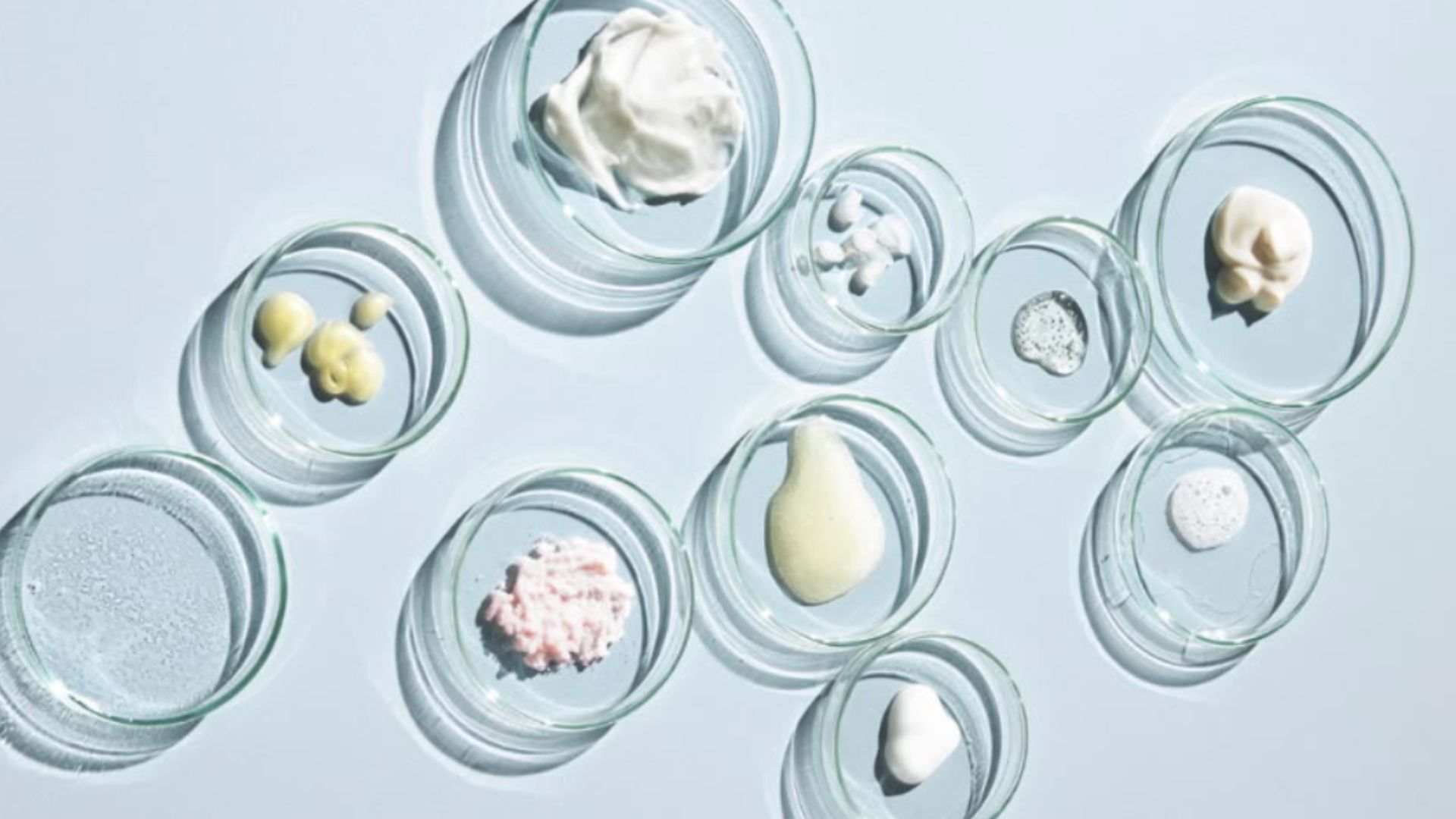
This is the "whole" form, the large protein. Very little chance of it penetrating. It mainly acts as a film-forming and surface moisturizing agent.
Not necessarily bad, just limited.
Hydrolyzed collagen
Here, collagen is broken down into smaller fragments (peptides). It is also found under the names: collagen peptides, hydrolyzed collagen, collagen peptides.
This is more interesting, because smaller fragments can interact differently with the skin. Be careful, this still doesn't mean they will "reconstruct" the dermis as if by magic, but we're moving beyond a simple surface layer.
In a well-formulated product, these peptides can:
- support hydration
- contribute to a feeling of firmness (due to film effect and retained water)
- sometimes send biological signals (depending on the peptide, depending on the technology), although here we are entering the realm of promises difficult to generalize
Gelatin
Sometimes used as well. It's a derived form of collagen. Same logic: film, feel, hydration.
And the real key: delivery technology
Because ultimately, the form of collagen matters... but the way it is applied matters even more.
In most conventional cosmetics, even hydrolyzed collagen acts mainly on the surface, with a temporary moisturizing and smoothing effect.
However, certain technologies completely change the game.
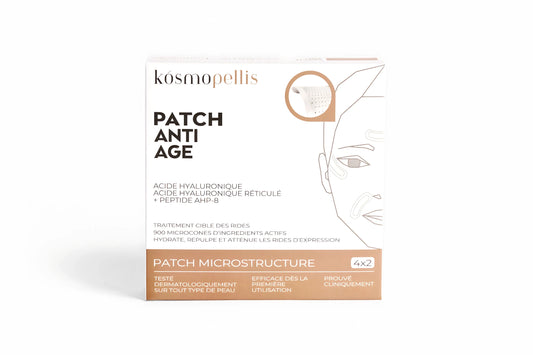
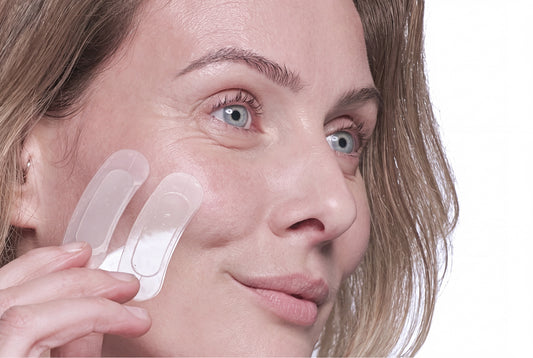
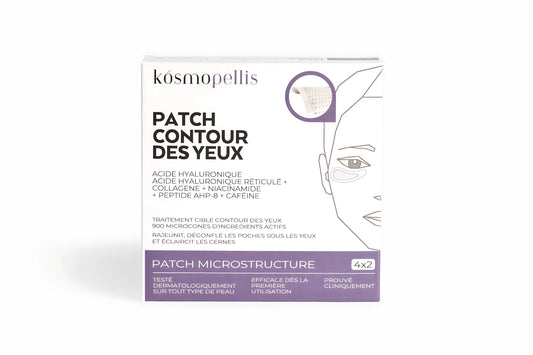
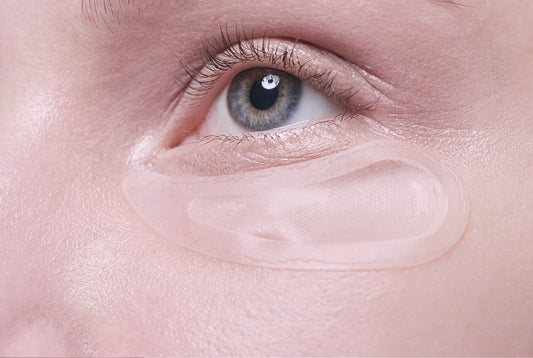
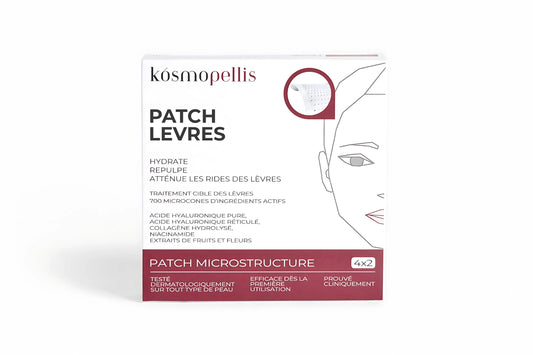
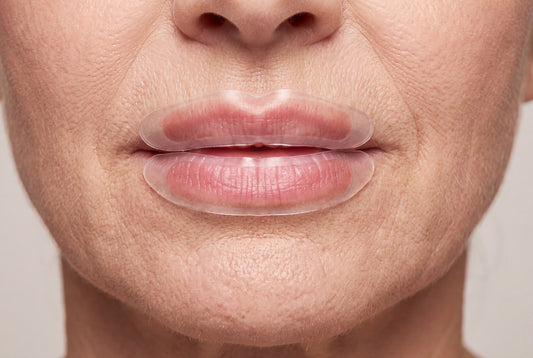
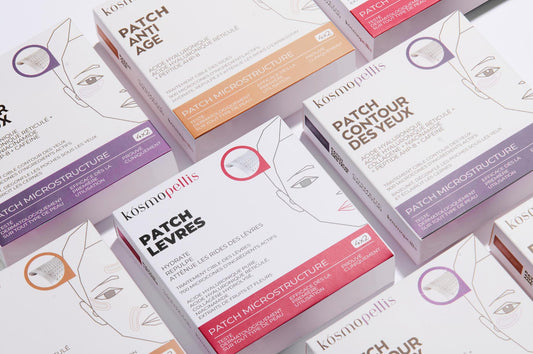
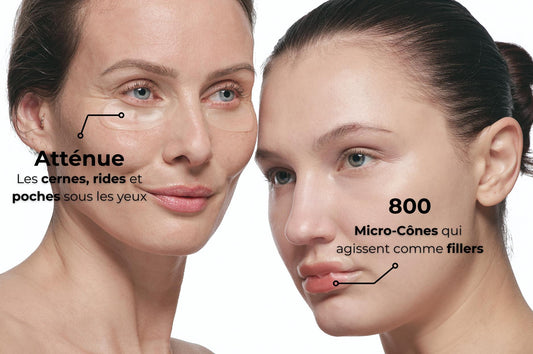
Kōsmopellis patches use self-dissolving micro-cone technology that allows active ingredients to be delivered directly into the superficial layers of the skin.
Specifically:
- the micro-cones penetrate the skin barrier
- they dissolve and release collagen, hyaluronic acid, and peptides
- the active ingredients are diffused where they are truly useful
👉 The result:
- better absorption
- a more visible plumping effect
- a more effective smoothing of the lips
Unlike a conventional cream, we don't rely solely on a surface effect.
We achieve a more targeted, deeper action — and above all, without causing irritation.
So... myth or real efficacy?
To summarize without beating around the bush.
- Myth: if you believe a collagen cream will replace the collagen you lose with age, deep down, and "erase" structural wrinkles.
- Real efficacy: if you are looking for a visible improvement in hydration, suppleness, comfort, and a slight temporary smoothing effect — this is where the benefits of collagen truly manifest in cosmetics.
It is effective as a cosmetic. Not as a reconstructive agent.
And that counts, by the way. Better hydrated skin often looks younger. But the mechanism needs to be clear.
What works better than collagen to stimulate collagen (yes, it's a bit ironic)

If your goal is truly to support skin collagen, the most robust active ingredients are not necessarily collagen itself.
Retinoids
Retinol, retinal, tretinoin (prescription only), etc. These are probably the best-known active ingredients for supporting skin renewal and improving the appearance of wrinkles, with a real biological rationale behind them.
However, they are not always easy to tolerate. Irritation, dryness, sensitivity... you have to proceed gradually.
Vitamin C (well-formulated)
Vitamin C is associated with collagen synthesis, and it also helps with radiance, spots, and uniformity. But it is demanding: stability, pH, packaging, and tolerance.
Not all "Vitamin Cs" are created equal.
Peptides (not necessarily collagen)
Some cosmetic peptides are used to target firmness, signaling, and the appearance of wrinkles. Again, this depends heavily on the formula and the exact peptide. But overall, it's often more relevant than native collagen applied to the surface.
Exfoliating acids (AHA, BHA) and renewal
Not directly "collagen," but good surface renewal, when done well, can improve texture and radiance, and give that smoother skin appearance. Be careful not to over-exfoliate.
And most importantly... sun protection
I know. It's the least sexy advice in the universe. But if you want to protect your collagen, the sun is one of the major degradation factors.
So SPF, sunglasses, hat, avoid baking in the sun. It's basic, but it's truly the foundation.
And what about drinkable collagen?
I know the subject here is "on the skin," but many people mix everything up, so it's best to clarify.
Collagen in supplements (collagen peptides) is a different discussion. Here, we're talking about ingestion, digestion into amino acids and peptides, then potential effects via physiology. Studies suggest modest benefits on hydration, elasticity, and sometimes the appearance of wrinkles, especially after several weeks.
But it's not instantaneous, and it depends on the dosage, quality, and context. And it's not a "new face."
So yes, it's another debate. Just don't confuse a collagen cream with a collagen supplement. Same word, different mechanisms.
How to spot a collagen cream that makes sense (and avoid pitfalls)
A few simple benchmarks, without becoming a chemist.
1. Look at the INCI list, calmly
If you see "collagen" at the very bottom of the list, in the last third, it's not necessarily bad, but the impact will likely be limited.
If you see "hydrolyzed collagen," it's generally more interesting than plain collagen, even if it remains primarily a comfort and surface active ingredient in most cases.
2. Look for the product's objective, not the word collagen
A good moisturizer can give you a better visual result than an average "collagen" product.
Also look at what else is in it: glycerin, hyaluronic acid, ceramides, squalane, panthenol... sometimes, they are the real heroes.
Collagen then acts more as a texture and film bonus.
3. Be wary of overly surgical promises
"Wrinkles filled," "collagen rebuilt," "lifting effect"... this vocabulary is often marketing.
A cream can smooth the appearance. It cannot remodel your dermal architecture like a medical procedure.
4. Tolerance matters more than ego
If a formula suits you, doesn't cause breakouts, and leaves your skin comfortable and stable, that's already a huge win.
Many routines fail because people want too much, too fast.
Who can really benefit from topical collagen?
I see it clearly in certain cases.
- Dehydrated skin: temporary smoothing effect, comfort, protective film.
- Mature skin that feels tight: some hydrolyzed collagen formulas can provide a softer, more "bouncy" feel daily.
- Sensitized skin (outside of inflammatory flare-ups): sometimes, a gentle film helps reduce discomfort. But this depends on the complete formula, not just the collagen.
However, if your main objective is: deep wrinkles, significant sagging, loss of volume... topical collagen will not be your number one lever. It can support, not lead the dance.
What I would do if I wanted an intelligent routine centered around collagen

Without infinitely layering products.
- Gentle cleanser (not stripping).
- Effective moisturizer (ceramides, glycerin, hyaluronic acid—whatever you tolerate).
- An active ingredient that truly stimulates, depending on your profile: retinoid or Vitamin C, gently.
- SPF in the morning, every day you see daylight.
- Topical collagen if you like the finish and comfort, as a bonus, not as the core strategy.
- And, if you want to go further in terms of efficacy, prioritize delivery technologies like micro-cones, which truly deliver collagen and active ingredients deep into the skin, rather than just keeping them on the surface.
And if your skin reacts to everything, I would simplify even further. Often, skin repairs itself when you stop bothering it, which also allows it to better enjoy the benefits of collagen.
Conclusion: collagen on the skin, yes... but let's put it in the right place
Collagen applied to the skin is not a total scam. It can hydrate, smooth a bit, improve texture, and give a "plumper skin" effect in the moment. So yes, there is real cosmetic efficacy, and the benefits of collagen are real in this context.
But if you expect a deep reconstruction of dermal collagen with just a cream, then we're in the realm of myth. The skin barrier doesn't let large molecules pass through like that, and most of the benefits are primarily superficial.
In practice: if you like your collagen cream, keep it. Just don't ask it to do the work of a retinoid, a good Vitamin C, and regular SPF.
It's less glamorous. But that's where skin truly changes, little by little. And sometimes, it comes down to details. A simple routine, maintained over time. Not a miracle ingredient.
Frequently asked questions
What is collagen and what is its role in the skin?
Collagen is a major protein found in skin, tendons, ligaments, and cartilage. In the skin, it contributes to its structure, firmness, and bouncy appearance by forming a support network with elastin and other components of the extracellular matrix.
Why does collagen production decrease with age?
Starting in your twenties, natural collagen production gradually begins to decline. This decline accelerates with sun exposure, smoking, pollution, stress, and poor sleep, leading to faster degradation of existing collagen.
Does collagen applied as a cream really penetrate the skin?
No, conventional collagen is a large molecule that cannot cross the skin barrier. Therefore, when applied as a cream, it primarily remains on the surface without penetrating the dermis to replace lost collagen.
What effects can topical collagen have on the skin?
Collagen applied topically can help form a protective hydrating film, improve the feeling of suppleness, temporarily smooth dehydration fine lines, and increase skin comfort. These effects are primarily cosmetic and related to hydration rather than deep reconstruction.
What are the differences between native and hydrolyzed collagen in cosmetics?
Native collagen is the entire protein, very large and poorly penetrating, acting primarily as a film-forming agent on the surface. Hydrolyzed collagen is broken down into smaller peptides that can interact better with the skin, support hydration, and contribute to a feeling of firmness due to their reduced size and potential biological properties.
Can collagen peptides really stimulate collagen production in the skin?
Certain peptides derived from hydrolyzed collagen can send biological signals that promote specific skin mechanisms. However, these effects depend on the type of peptide and the technology used in the formula. They do not guarantee a magical reconstruction of the dermis but can generally support skin health.